01Experience layer
Customer-banker chatbots handle Q&A and guided journeys across every channel.
POWERED BY CORTEX
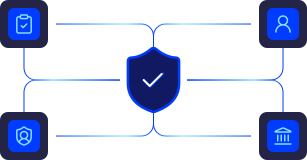
Cornytis is built on four guarantees: data stays in-bank, decisions are auditable, the system continuously improves, and core banking systems stay untouched.
Cornytis is built on four guarantees: in-bank data, auditable decisions, continuous improvement, and untouched core banking systems.
Customer-banker chatbots handle Q&A and guided journeys across every channel.
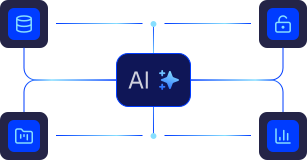
The AI fabric manages memory, routing, retrieval, tools, and responses through clear business rules.
Chatbots guide customer-bank interactions with personalized support across all channels.
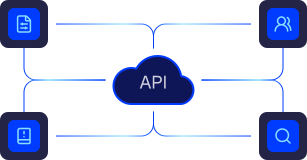
Core banking, KYC, and credit systems connect via OpenAPI APIs without custom connectors.
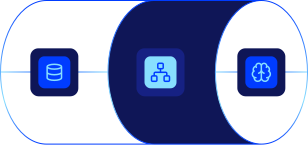
A vector store and Neo4j graph allow for relationship-aware retrieval of regulatory texts.
Genesis handles tenant isolation and audits, while Shipyard and Evolution manage deployment.
Agents become the new APIs. Business logic lives in plain language, not code. When a regulation changes, the compliance officer updates a description — not an IT ticket.
Cornytis runs as eight independently scalable microservices, powering AI agents and deterministic banking workflows.
Manages tenants, users, roles, and API keys. Every request is authenticated and scoped to the correct organisation before any agent logic runs.
Powers all AI-driven conversations. Orchestrates the full reasoning loop: memory consolidation, intent routing, RAG retrieval, tool selection, streamed response generation.
Executes deterministic, multi-step processes — loan applications, onboarding, approval chains. Supports human-in-the-loop pauses with role-gated approvals. State persists across sessions via LangGraph checkpoints.
Stores regulatory texts, product rules, and policy documents as vector embeddings and a Neo4j knowledge graph. GraphRAG combines semantic search with relationship traversal.
Connects agents to any external system — credit bureaus, KYC providers, core banking APIs — via OpenAPI import. Configuration-based integrations for standard services; secure sandboxed extensions for domain-specific logic.
Serves embeddable chat widgets and translates agent state into frontend UI schemas — forms, approval buttons, progress screens.
Provisions and manages the full stack on the bank's own AWS or on-premise infrastructure. The Data Plane — agents, knowledge base, LLM calls — never leaves the bank's environment.
Monitors agent performance, detects failures, proposes targeted optimisations, validates changes against a regression vault before promoting them to production.
Most AI platforms force every process through one execution model. Cornytis routes each banking task to the runtime that fits its nature — which is what makes the platform simultaneously flexible and auditable.
Probabilistic · language-driven
Handles open-ended reasoning: customer chat, document Q&A, fraud pattern detection, plain-language rule interpretation. Streamed in real time via SSE.
Deterministic · guaranteed step order
Executes structured process graphs: collect data, call APIs, branch on conditions, pause for human approval, resume. Every step logged. State persists across sessions via LangGraph checkpoints.
Hippocampus combines two complementary stores so agents can retrieve the right rule and context for every case.
Documents like regulatory texts, product sheets, and policy manuals are processed and embedded. During inference, the agent retrieves the most relevant chunks for the query. Supported formats include PDF, DOCX, CSV, JSON, and HTML.
Entities from documents, such as regulations and customer profiles, are stored as nodes and relationships. During queries, retrieval uses vector similarity and graph traversal, allowing the agent to answer questions that require reasoning across related entities.
Not a configuration choice but an architectural constraint: Cornytis separates into two planes to keep data and AI operations inside the bank's perimeter.
Cornytis enforces it at every layer — and the controls below are not opt-in.
Every query is filtered by tenant_id at the ORM layer, making each bank's data structurally invisible to other tenants.
Three core roles — Super Admin, Tenant Admin, and User — with granular API-level permissions for builders, operators, and viewers.
Every agent decision is traceable, every conversation searchable, and performance trends surfaced automatically — regulator-ready by default.
Databases and backend services run in private subnets, with public access limited through a load balancer. Egress controls, rate limiting, and WAF rules prevent exfiltration, SQL injection, and XSS.
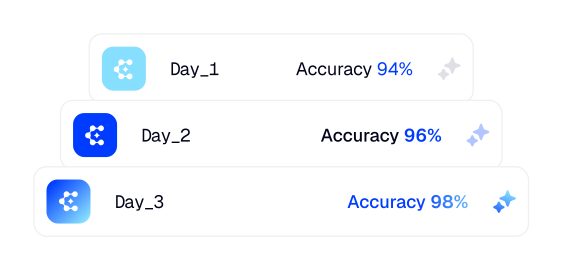
Most AI systems degrade over time. Cornytis continuously improves through automated feedback loops.
When an agent interaction fails — wrong tool selection, hallucinated output, latency threshold exceeded, or a user thumbs-down — the system:
Categorises failures and selects the right optimisation strategy.
Proposes precise changes to the agent configuration.
Validates updates against a vault of test cases.
Deploys changes to production only after passing validation.
The banking industry is converging on AI-first architecture. Cornytis is a fast, low-friction path to get there — without replacing core systems, without multi-year migrations, and without compromising governance or control.
See Cornytis in action with a live walkthrough tailored to your operations.